
The BSc (BMSC) Program
In 2021-22, the College of Arts and Science, in an exciting partnership with the College of Medicine, introduced the new collaborative degree, a Bachelor of Science in Biomedical Sciences (BSc (BMSC)).
These programs include the necessary courses for students preparing to enter graduate studies in biomedical sciences or into health-related professional schools such as Medicine, Dentistry, Veterinary Medicine, Pharmacy and Nutrition.
Bachelor of Science in Biomedical Sciences
There are five degree options in Biomedical Sciences:
This program provides education in disciplines of the anatomical sciences (cell biology, developmental biology, and gross anatomy), physiology and pharmacology. These life science disciplines provide a comprehensive understanding of the functions and mechanisms of actions of the cells and major systems of the human body, and of the effects and mode of action of chemicals which modify the major systems of the body.
Please click here to view this program in the University Catalogue.
This program includes education in many of the major topics in neuroscience including molecular and cellular neuroscience, systems and sensory neuroscience, behavioural and cognitive neuroscience, neurophysiology and neuroanatomy.
Please click here to view this program in the University Catalogue.
This program which provides education in the areas the molecular and cellular approaches to the study of the life sciences including microbial physiology and pathogenesis, protein structure and function, molecular biology, microbial genetics, virology, tumour biology and cancer, immunology and immunopathogenesis.
Please click here to view this program in the University Catalogue.
The Departments of Anatomy, Physiology, and Pharmacology and Biochemistry, Microbiology, and Immunology offer this program that enables cutting-edge, multi-disciplinary training that positions graduates for careers in the biomedical sciences as well as health-related professions.
Please click here to view this program in the University Catalogue.
This program builds on the shared two-year biomedical sciences platform shared by all the biomedical science majors to provide students with a strong foundation of multi-disciplinary training while providing flexibility for initial specialization within a particular biomedical science. This program includes necessary courses for students prepared to enter into health-related professional schools not requiring a four-year degree such as Dentistry, Veterinary Medicine and Pharmacy.
Please click here to view this program in the University Catalogue.
Recommended 2-year Course Sequencing
The first two years of all BMSC programs include core courses indicated below. These two years ensure students build a solid foundation moving forward in the program. The BMSC courses incorporate content from each of the Biomedical Science areas of study to broaden student knowledge and create versatility in their studies.
2-year schedule sample
This degree program is flexible and offers you the opportunity to take courses in many different subject areas. Here is what a typical first-year schedule might look like:
| Course | Description |
|---|---|
Fall Term |
|
| BIOL 120b | The Nature of Life |
| CHEM 112b | General Chemistry I Structure Bonding and Properties of Materials |
| PHYS 115b | Physics and the Universe |
| INDG 107c | Introduction to Canadian Indigenous Studies |
| ENG 112d | Literature and Composition Reading Drama |
Winter Term |
|
| BMSC 200a | Biomolecules |
| CHEM 115b | General Chemistry II Chemical Processes |
| PHYS 117b | Physics for the Life Sciences |
| PSY 120b | Biological and Cognitive Bases of Psychology |
| ART 110e | Art Today Ideas and Practices |
a Required course for the M4 Core Requirement
b Course from the Cognate Requirement
c Or other course listed under the Indigenous Learning Requirement could be chosen
d Or other course listed under the English Language Writing Requirement could be chosen
e Or other course listed under the Breadth or Elective Requirement could be chosen
The Course and Program Catalogue has the complete and official listing of required classes and their descriptions for this program.
This degree program is flexible and offers you the opportunity to take courses in many different subject areas. Here is what a typical second-year schedule might look like:
| Course | Description |
|---|---|
Fall Term |
|
| BMSC 207a | Human Body Systems I |
| BMSC 210a | Microbiology |
| BMSC 240a | Laboratory Techniques |
| CHEM 250a | Introduction to Organic Chemistry |
| MUS 101c | Fundamentals of Music I Exploring Foundations |
Winter Term |
|
| BMSC 208a | Human Body Systems II |
| BMSC 220a | Cell Biology |
| BMSC 230a | Metabolism |
| MATH 110b | Calculus I |
| ARCH 112c | The Human Journey Introduction to Archaeology and Biological Anthropology |
a Required course for the M4 Core Requirement
b Or other course listed under the Quantitive Reasoning Requirement chould be chosen
c Or other course listed under the Cognate, Breadth or Elective Requirements chooud be chosen
The Course and Program Catalogue has the complete and official listing of required classes and their descriptions for this program.
The M4 Core Requirements must be finished before a student can declare intent in a BSc (BMSC) major. There are no exceptions to this rule.
The M4 Core Requirements (24 credit units) consist of the following classes:
- BMSC 200.3 Biomolecules
- BMSC 207.3 Human Body Systems I
- BMSC 208.3 Human Body Systems II
- BMSC 210.3 Microbiology
- BMSC 220.3 Cell Biology
- BMSC 230.3 Metabolism
- BMSC 240.3 Laboratory Techniques
- CHEM 250.3 Introduction to Organic Chemistry
These classes must be finished before a student can declare intent in a BSc (BMSC) major.
Declare Intent and Transfer details for current students
Arts & Science students are required to have a passing grade (50% minimum) in
- 100-level or higher BIOL, CHEM, and MATH
to be eligible to transfer into the BSc (BMSC) program.
If there are deficiencies in any of these requirements at the time of transfer, high school grades will be reviewed (Chemistry 30, Biology 30, and Math Foundations 30, each with a minimum average of 70%).
The transfer process is initiated annually from March 1st until April 30th by filling out the survey.
If you are a current BSc (BMSC) student, you do not have to transfer but can declare intent for a major once you have completed the M4 Core Requirements by April 30th.
*If you started your program prior to 2020 and are currently declared in a past major (ACB, BIOC, MCIM, PHPY) you can choose to continue with that major or declare intent for a new major in the BSc (BMSC) program.
How can I declare the 3-year BSc (BMSC) Biomedical Foundations major (BMF)?
Once you are accepted into the BSc (BMSC) program, you will have an undeclared major. You can switch to three-year BMF program at any time through the ‘A&S Inquiry’ form.
How can I declare one of the BSc (BMSC) 4-year majors?
The process to declare a BMSC 4-year major is slightly different from other A&S programs. You need to complete the M4 Core Requirements by the end of April in the year you want to declare a major (traditionally completed in 2nd year). These classes must be completed by April 30th, 2024 to declare a major for the 2024-25 academic year.
M4 Core Requirements (24 credit units)
- BMSC 200.3 Biomolecules
- BMSC 207.3 Human Body Systems I
- BMSC 208.3 Human Body Systems II
- BMSC 210.3 Microbiology
- BMSC 220.3 Cell Biology
- BMSC 230.3 Metabolism
- BMSC 240.3 Laboratory Techniques
- CHEM 250.3 Introduction to Organic Chemistry
The survey to declare a major is open annually from March 1st to April 30th and must be completed by April 30, 2024, for the 2024-25 academic year. Once the survey closes, student eligibility will be checked and placement for majors ranked (if requesting a program with limited seats). You will be informed of your placement at the beginning of May of the year you are eligible to declare intent via your USask email.
*If you started your program prior to 2020 and are currently declared in a past major (ACB, BIOC, MCIM, PHPY) you can choose to continue with that major or declare intent for a new major in the BSc (BMSC) program.
What if I do not meet the requirements to choose a major?
We encourage you to declare the following year once all criteria are met. You can apply to transfer to the BSc (BMSC) program before you're eligible to declare intent for a major if you meet the admission requirements.
Is space limited in some majors?
Yes, there is limited capacity (40 seats) in the Biomedical Neuroscience (BMNS) and the Interdisciplinary Biomedical Science (ID BMSC) majors.
If student demand is greater than the program's capacity, all eligible students will be ranked by their average in the courses included in the criteria to declare a major. The top students will be accepted into the major and the remaining placed in their second choice. Students should not complete third year courses in ID BMSC or BMNS unless they have secured a seat in the major.
The survey is open annually from March 1 to April 30.
Announcements - Major, Course and Program
Course Updates for 2024-2025
(last updated April 15, 2024)
This document includes important BMSC course and program changes for the upcoming year to assist with planning and registration for the 2024-2025 year.
CPPS 310.3: Basic Human Anatomy - this course will only be offered in Fall Term in 2024-25.
CPPS 330.3: The Principles of Developmental Biology – will not be offered in 2024-25.
CPPS 331 - Authentic research experience in 3rd year lab class
CPPS 331: Methods in Cell and Developmental Biology - This hands-on course provides students with experience in multiple lab techniques common to cell biology using eukaryotic cells which includes tissue culture and fluorescence microscopy. Teams of students are guided to apply the scientific method to create their own hypothesis and experiment(s) using mammalian cells. This provides an authentic research experience and allows students to develop skills in tissue culture techniques, collaborative problem solving, analysis of original data, and strengthening scientific reporting skills.
CPPS 400: Clinical and Biomedical Imaging
Prerequisite(s): PHYS 115.3, PHYS 117.3 (or PHYS 125.3); and CPPS 310.3.
*Note: Overrides through the electronic override system will be accepted starting May 17, 2024 to avoid delays in June registration. Please add the course coordinator as the approver of this ticket.
CPPS 401.3: Human Skeletal Biology Across the Lifespan – New course* Winter Term
This course explores the skeleton, focusing on bone, as a dynamic organ system, which undergoes complex morphological and microstructural change across our lifespans. The histology and cell biology of bone are first reviewed to provide a foundation for understanding the basis for skeletal changes. Next, the course provides a life-span perspective on normal physiological and common pathological processes that play out across our lives including: 1) growth and development, 2) maintenance in adulthood, and, ultimately, 3) senescence. Theoretical perspectives as well as analytical methods (e.g. histological, molecular, imaging) are integrated into the discussion of relevant topics. This course is intended for those with an interest in skeletal biology, spanning the natural and social sciences, as well as those interested in biomedicine and the related clinical subfields.
Prerequisite(s): One of CPPS 310.3, CPPS 221.3, ANTH 270.3 or ANTH 470.3
BMIS 317.3: Introductory Virology - New course* Fall Term
The introductory virology course will explore the basic concepts about the biology of viruses with special focus on human viral pathogens. The major scientific milestones in the field of virology and the common themes in the replication cycle of major groups of viruses will be discussed. The topics covered include virus entry into cells, replication, production of infectious particles and transmission between host organisms, host-virus interactions, host antiviral immune responses, viral countermeasures to host defenses, vector transmission of viruses, vaccines, antivirals, viral diagnostics, surveillance, viral vectors, oncolytic viruses, techniques used to study viruses etc. Additionally, selected major human viral diseases and the biology of the associated viruses will be discussed in detail.
Prerequisite(s): BMSC 200.3, BMSC 210.3 and BMSC 230.3.
BMIS 319.3: Vaccinology Principles and Practice – New course* Fall Term
This course will provide a multidisciplinary introduction to the field of vaccinology. This includes historical perspectives on the emergence and evolution of vaccines, to modern strategies of vaccine development, formulation, and delivery. Through consideration of the processes involved in licensing and manufacturing, students will gain insight into the mechanisms and priorities to ensure vaccine efficacy and safety. The impacts of vaccines on human and animal health, including mechanisms of vaccine-induced protection, both at individual and population levels, will be considered and supported by case studies.
Prerequisite(s): BMSC 210.3.
BMIS 325.3: Fundamentals of Bacteriology - New course* Winter Term
This course explores how bacteria perform essential functions and adapt to diverse environments. You will learn about the bacterial cell envelope and surface, import and export of nutrients and macromolecules, regulation of gene expression and processes, and how bacteria generate specialized cellular forms. You will examine these topics through the analysis of classic and current literature, using a combination of lectures, activities and discussions. You will also gain an understanding of how bacterial processes are relevant for human health and biotechnology, such as the development of new antibiotics and vaccines
Prerequisite(s): BMSC 210.3 and BMSC 230.3
BMIS 498.3 (Special Topics Course): Advances in Antimicrobial Resistance of One Health Pathogens
Course Description: Themes related to antimicrobial resistance in the USask signature area of One Health will be covered through the presentation and discussion of primary research articles. Students are required to study all the manuscripts ahead of time and are encouraged to actively participate in the in-class discussion. An emphasis will be placed on the critical analysis of the research articles discussed. Methods generally applicable and of interest to the field will also be discussed.
Prerequisite: BMSC 320.3
BMI majors: BMIS 498.3 can be used in the M5 ‘choose 9cu’ 4-year and ‘choose 15cu’ honours to be included in “Any BMSC, BMIS, BIOC or MCIM course at the 300 or 400 level” note for that section.
BMIS 498.3 (Special Topics Course): Molecular Basis of Symbiosis and Microbiomes
Course Description: An introduction to the molecular bases of multiorganismal interactions from theory to well-established models involving microbes. This course emphasizes the importance of functional biological units and methods to study interactions between organisms. After an introduction to the field, students will read and present relevant literature.
Prerequisites: BMSC 320.3 and BMIS 308.3
BMI majors: BMIS 498.3 can be used in the M5 ‘choose 9cu’ 4-year and ‘choose 15cu’ honours to be included in “Any BMSC, BMIS, BIOC or MCIM course at the 300 or 400 level” note for that section.
The following notices are for the specific majors:
Biochemistry, Microbiology, and Immunology (BMI) Announcements for 2024-2025
(last updated April 15, 2024)
BMIS 317.3: Introductory Virology - New course* Fall Term
The introductory virology course will explore the basic concepts about the biology of viruses with special focus on human viral pathogens. The major scientific milestones in the field of virology and the common themes in the replication cycle of major groups of viruses will be discussed. The topics covered include virus entry into cells, replication, production of infectious particles and transmission between host organisms, host-virus interactions, host antiviral immune responses, viral countermeasures to host defenses, vector transmission of viruses, vaccines, antivirals, viral diagnostics, surveillance, viral vectors, oncolytic viruses, techniques used to study viruses etc. Additionally, selected major human viral diseases and the biology of the associated viruses will be discussed in detail.
Prerequisite(s): BMSC 200.3, BMSC 210.3 and BMSC 230.3.
BMIS 319.3: Vaccinology Principles and Practice – New course* Fall Term
This course will provide a multidisciplinary introduction to the field of vaccinology. This includes historical perspectives on the emergence and evolution of vaccines, to modern strategies of vaccine development, formulation, and delivery. Through consideration of the processes involved in licensing and manufacturing, students will gain insight into the mechanisms and priorities to ensure vaccine efficacy and safety. The impacts of vaccines on human and animal health, including mechanisms of vaccine-induced protection, both at individual and population levels, will be considered and supported by case studies.
Prerequisite(s): BMSC 210.3.
BMIS 325.3: Fundamentals of Bacteriology - New course* Winter Term
This course explores how bacteria perform essential functions and adapt to diverse environments. You will learn about the bacterial cell envelope and surface, import and export of nutrients and macromolecules, regulation of gene expression and processes, and how bacteria generate specialized cellular forms. You will examine these topics through the analysis of classic and current literature, using a combination of lectures, activities and discussions. You will also gain an understanding of how bacterial processes are relevant for human health and biotechnology, such as the development of new antibiotics and vaccines
Prerequisite(s): BMSC 210.3 and BMSC 230.3
BMIS 498.3 (Special Topics Course): Advances in Antimicrobial Resistance of One Health Pathogens
Course Description: Themes related to antimicrobial resistance in the USask signature area of One Health will be covered through the presentation and discussion of primary research articles. Students are required to study all the manuscripts ahead of time and are encouraged to actively participate in the in-class discussion. An emphasis will be placed on the critical analysis of the research articles discussed. Methods generally applicable and of interest to the field will also be discussed.
Prerequisite: BMSC 320.3
BMI majors: BMIS 498.3 can be used in the M5 ‘choose 9cu’ 4-year and ‘choose 15cu’ honours to be included in “Any BMSC, BMIS, BIOC or MCIM course at the 300 or 400 level” note for that section.
BMIS 498.3 (Special Topics Course): Molecular Basis of Symbiosis and Microbiomes
Course Description: An introduction to the molecular bases of multiorganismal interactions from theory to well-established models involving microbes. This course emphasizes the importance of functional biological units and methods to study interactions between organisms. After an introduction to the field, students will read and present relevant literature.
Prerequisites: BMSC 320.3 and BMIS 308 .3
BMI majors: BMIS 498.3 can be used in the M5 ‘choose 9cu’ 4-year and ‘choose 15cu’ honours to be included in “Any BMSC, BMIS, BIOC or MCIM course at the 300 or 400 level” note for that section.
Biomedical Neuroscience Announcements for 2024-2025
*These notices are only for students who have been officially accepted into the BMNS major
Changes to the BMNS major in the 2023-2024 calendar
Learn about the differences in the 2022-2023 and 2023-2024/Current program catalogues.
What is the program catalogue?
The program catalogue displays the most current calendar requirements in a degree. In March each year the newest catalogue is released for the next academic year.
Which BMNS calendar year should I follow?
All current BMNS students are encouraged to switch to the 2022-2023 or 2023-2024/Current calendar because new courses have been added, providing more flexibility.
Differences between the calendars:
|
BMNS 2022-2023 year |
BMNS 2023-2024 year/Current |
|
M5 section: ‘Choose 3 cu’ NEUR 420 ‘Choose 6 cu’ PSY 242 |
M5 section: ‘Choose 6 cu’ NEUR 420 ‘Choose 3 cu’ PSY 242 |
*BIOL 430 is offered every other year – it will be offered 2024-2025
How do I switch calendar years?
Once you are officially accepted in BMNS major, you can switch calendar years by submitting a request through an ‘A&S Inquiry’ form.
Cellular Physiological and Pharmacological (CPPS) Announcements 2024-2025
(last updated April 11, 2024)
CPPS 310.3: Basic Human Anatomy - this course will only be offered in Fall Term in 2024-25.
CPPS 330.3: The Principles of Developmental Biology – will not be offered in 2024-25.
CPPS 331 - Authentic research experience in 3rd year lab class
CPPS 331: Methods in Cell and Developmental Biology - This hands-on course provides students with experience in multiple lab techniques common to cell biology using eukaryotic cells which includes tissue culture and fluorescence microscopy. Teams of students are guided to apply the scientific method to create their own hypothesis and experiment(s) using mammalian cells. This provides an authentic research experience and allows students to develop skills in tissue culture techniques, collaborative problem solving, analysis of original data, and strengthening scientific reporting skills.
CPPS 400: Clinical and Biomedical Imaging
Prerequisite(s): PHYS 115.3, PHYS 117.3 (or PHYS 125.3); and CPPS 310.3.
*Note: Overrides through the electronic override system will be accepted starting May 17, 2024 to avoid delays in June registration. Please add the course coordinator as the approver of this ticket.
CPPS 401.3: Human Skeletal Biology Across the Lifespan – New course* Winter Term
This course explores the skeleton, focusing on bone, as a dynamic organ system, which undergoes complex morphological and microstructural change across our lifespans. The histology and cell biology of bone are first reviewed to provide a foundation for understanding the basis for skeletal changes. Next, the course provides a life-span perspective on normal physiological and common pathological processes that play out across our lives including: 1) growth and development, 2) maintenance in adulthood, and, ultimately, 3) senescence. Theoretical perspectives as well as analytical methods (e.g. histological, molecular, imaging) are integrated into the discussion of relevant topics. This course is intended for those with an interest in skeletal biology, spanning the natural and social sciences, as well as those interested in biomedicine and the related clinical subfields.
Prerequisite(s): One of CPPS 310.3, CPPS 221.3, ANTH 270.3 or ANTH 470.3
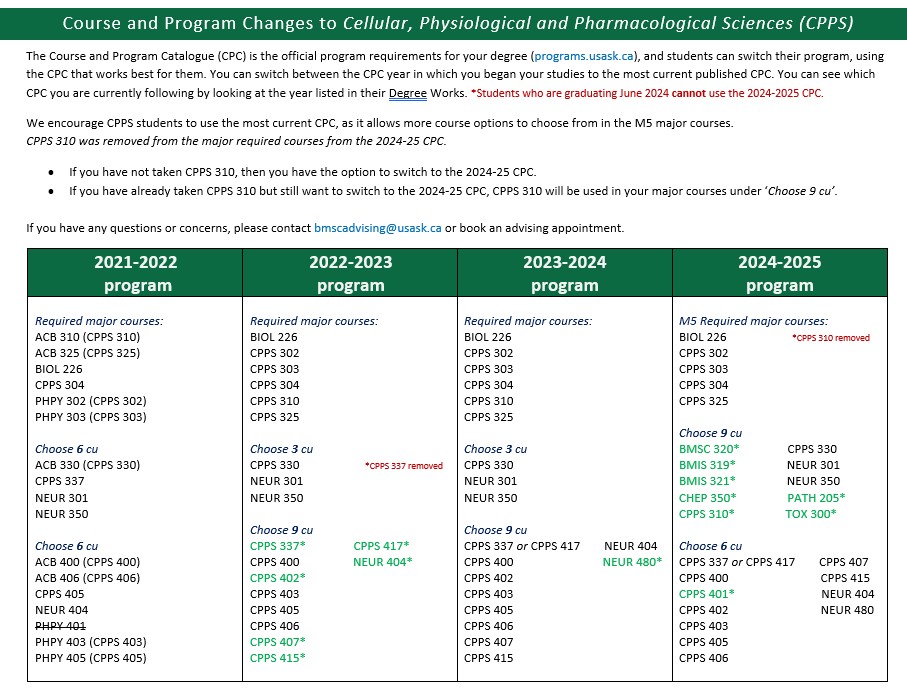
CPPS Course and Program changes for 2024-25 academic year:
Interdisciplinary Biomedical Sciences (ID BMSC) Announcements for 2024-2025
*These notices are only for students who have been officially accepted into the ID BMSC major
CHEP 350 Registration Process
Students who completed statistic regulation equivalent will be eligible to register without a prerequisite override.
CHEP 350: Introduction to Epidemiology
Prerequisite(s): STAT 244.3, STAT 245.3, or STAT 246.3 or PLSC 214.3
Anatomy and Cell Biology Announcements for 2024-2025
The following notice is for students who are following the BSc Anatomy and Cell Biology (ACB) program. The BSc in ACB is only available to students who started their program prior to 2020 and are currently declared in the ACB major.
CPPS 405 seats are limited
If you require CPPS 405: Current Topics in Cellular Physiological and Pharmacological Sciences to complete your ACB degree please contact bmscadvising@usask.ca as soon as possible to secure a seat.
Biochemistry (BIOC) Course Notices 2024-2025
The following notice is for students who are following the BSc Biochemistry (BIOC) program. The BSc in BIOC is only available to students who started their program prior to 2020 and are currently declared in the BIOC major.
Bioinformatics Options
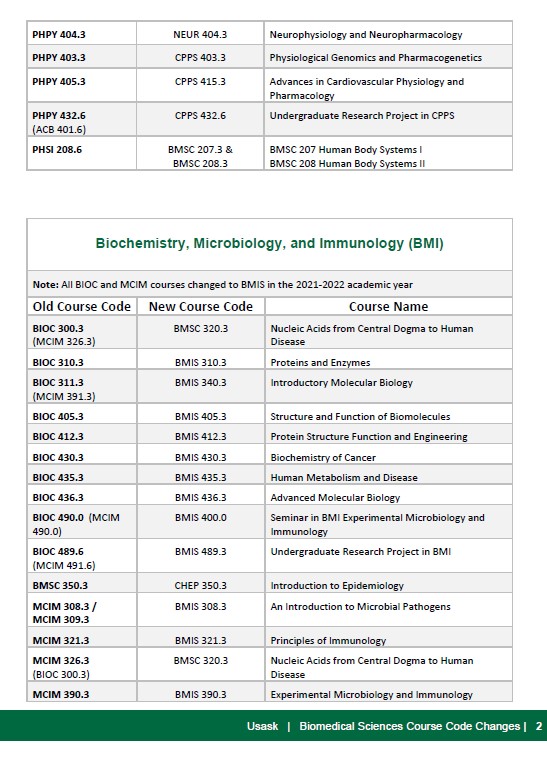
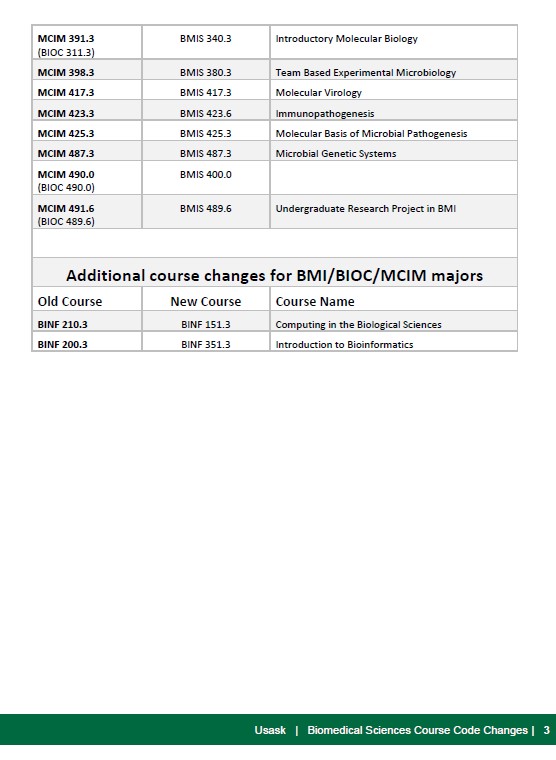
The BIOC major requires BINF 200 or BINF 210 in the area of major. Please note the following course code changes for 2022-2023 moving forward. Students can take one of the following options to complete this requirement.
BINF 151.3 (formerly BINF 210 in the program)
BINF 351.3 (formerly BINF 200 in the program)
This change is not reflected in the course catalogue but either course will be accepted. Take note that BINF 151 is a junior credit, whereas BINF 351 is a senior credit (200+). All 4-year/honours degrees must meet a minimum of 66 SR level credits in their degree.
Microbiology and Immunology (MCIM) Course & Program Notices as of 2024-2025
The following notice is for students who are following the BSc Microbiology and Immunology (MCIM) program. The BSc in MCIM is only available to students who started their program prior to 2020 and are currently declared in the MCIM major.
MCIM 416
This course is no longer offered; this change is not reflected in the program catalogue or DegreeWorks.
If you have not completed MCIM 416, any 300 level MCIM course that is not already required for the degree will be accepted in its place. Current options include: BMIS 308.3 (formerly MCIM 308.3, 309.3, either will be accepted), or BMIS 380.3 (formerly MCIM 398.3), or BMIS 425.3 (formerly MCIM 425.3)
CHEP 350.3 Course Inclusion
MCIM majors can use CHEP 350.3 (formerly BMSC 350.3) as a C6 restricted elective option in area of major
*This course is currently not accepted as a replacement for MCIM 416.3
BINF 151 (formerly BINF 210)
BINF 151 (formerly BINF 210) is an accepted option for MCIM majors.
MCIM students have the option to take either BINF 351.3 (formerly BINF 200.3) BINF 151 (formerly BINF 210.3), instead of just BINF 351.3 as the only option. This change is not reflected in the course catalogue but either course will be accepted.
NOTE: BINF 151 is a junior credit, whereas BINF 351 is a senior credit (200+). All 4-year/honours degrees must meet a minimum of 66 SR level credits in their degree.
Physiology & Pharmacology (PHPY) Notices for 2024-2025
The following notice is for students who are following the BSc Physiology and Pharmacology (PHPY) program. The BSc in PHPY is only available to students who started their program prior to 2020 and are currently declared in the PHPY major.
Additional options added to area of major
The following has been added to the C6 area of major options in the PHPY major for 2019-2020 catalogue for the 2023-2024/Current year
in the ‘choose 6 cu’ section(s):
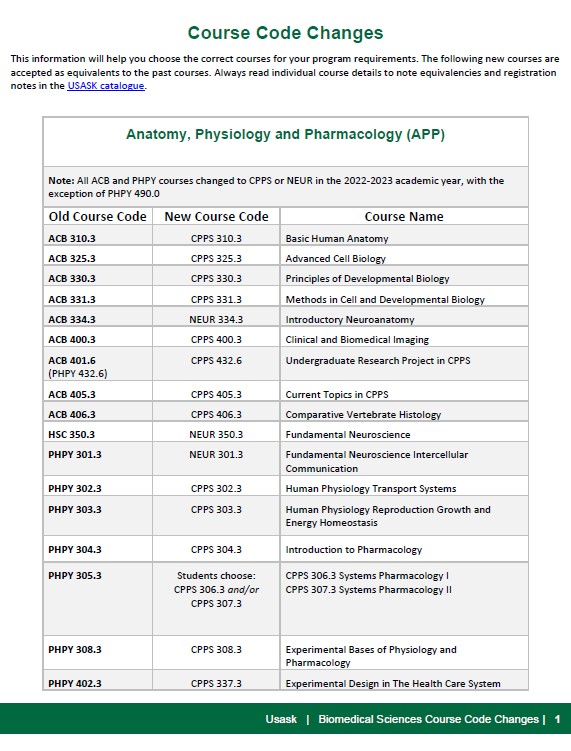
CPPS 337 (formerly PHPY 402) or CPPS 417
CPPS 403 (formerly PHPY 403)
NEUR 404 (formerly PHPY 404)
CPPS 415 (formerly PHPY 405)
CPPS 400 (formely ACB 400)
CPPS 406 (formerly ACB 406)
Students who have not yet completed CPPS 310 can request a prerequisite override to register for CPPS 400 before or alongside CPPS 310. The course will cover all related anatomy content needed in the course. This course is intended for 3rd and 4th year students.
CPPS 400: Clinical and Biomedical Imaging
Prerequisite(s): PHYS 115.3, PHYS 117.3 (or PHYS 125.3); and CPPS 310.3.
*Note: Overrides through the electronic override system will be accepted starting May 17, 2024 to avoid delays in June registration. Please add the course coordinator as the approver of this ticket.
PHPY 490.0 Process
PHPY majors are required to complete the seminar course: PHPY 490.0, for the major requirement in their final year. Students completing PHPY 490.0 will register for the course and receive an automatic pass for the course. Students will receive notifications for departmental seminars, but attendance is not mandatory and there will not be any scheduled content or coursework associated with the course. If you have any time conflicts with PHPY 490.0, ensure you register in the conflicting class first, then request the time conflict override to PHPY 490.0.
*Note: Overrides through the electronic override system will be accepted starting May 17, 2024 to avoid delays in June registration. Please add the course coordinator as the approver of this ticket.
Academic Advising
Academic advising is available to help you successfully plan your program and support your career goals. It’s a great idea to meet with an academic advisor once a year throughout your studies, or anytime you have questions or concerns about your academic planning or progress.
As a BMSC student, you are encouraged to meet with an Arts and Science Academic Advisor as well as with the Biomedical Sciences Academic Advisor throughout your program.
To Book an Appointment
The Biomedical Sciences Advisor will be processing the results of the Declare Intent and/or Transfer survey between Wednesday, May 1st to Friday, May 10th, 2024.
During this time, appointments will NOT be available. They will be available via email, but responses to emails may be delayed. Thank you for your patience.
Please feel free to check back and to book an appointment for after May 10th, 2024.
Arts and Science Advisors can help with:
- outside of major questions or concerns
- confirmation of program and degree requirements
- clarification of academic policies and procedures
- academic appeals, deferred exam requests, graduation checks
- visiting student requests, second degree requirements
- inquiries about "required to discontinue" notices and probation status
- discussion of confirmed transfer credits
- strategies for applying to other colleges
- academic strategies to strengthen grades
The Undergraduate Student Office offers in-person and remote academic advising apppointments. You will find the link to book an appointment under the Arts and Science Channel in PAWS. Students can schedule an appointment with an academic advisor up to 14 days in advance.
Academic advising appointments are available at the following hours:
- Monday – Friday: 9:00 am – 12:00 noon and 1:00 to 4:00 pm
- Tuesday and Thursday: 5:00 pm – 8:00 pm
Log into PAWS, and go to the Arts and Science Channel. In the Student Academic Services section, click on Book an Appointment.
Undergraduate Advisor
Robin Parent
Phone: 306-966-1199
Room GA20.3 Health Sciences
bmscadvising@usask.ca
Map To GA20 in Health Sciences
For more information, please contact:
| Program | Undergraduate Chair |
| Anatomy, Physiology & Pharmacology | Dr. Landon Baillie |
| Biochemistry, Microbiology and Immunology | Dr. Kyle Anderson |